Designed with the best filtration and disinfection systems.
- +917096592479
- Mon - Sat: 08.00 to 08.00
Chemical-Free Purification for Softening & Deionization
Water Link Technologies offers Ion Exchange Systems for water softening, demineralization, and dealkalization using specially formulated resin beds. These systems effectively remove hardness ions, heavy metals, and other unwanted ions to produce chemically pure water for critical processes. Ideal for boiler feed, cooling systems, and laboratories, our systems are designed for high flow rates, minimal chemical usage, and low operating costs."Softener" are terms used in different contexts:

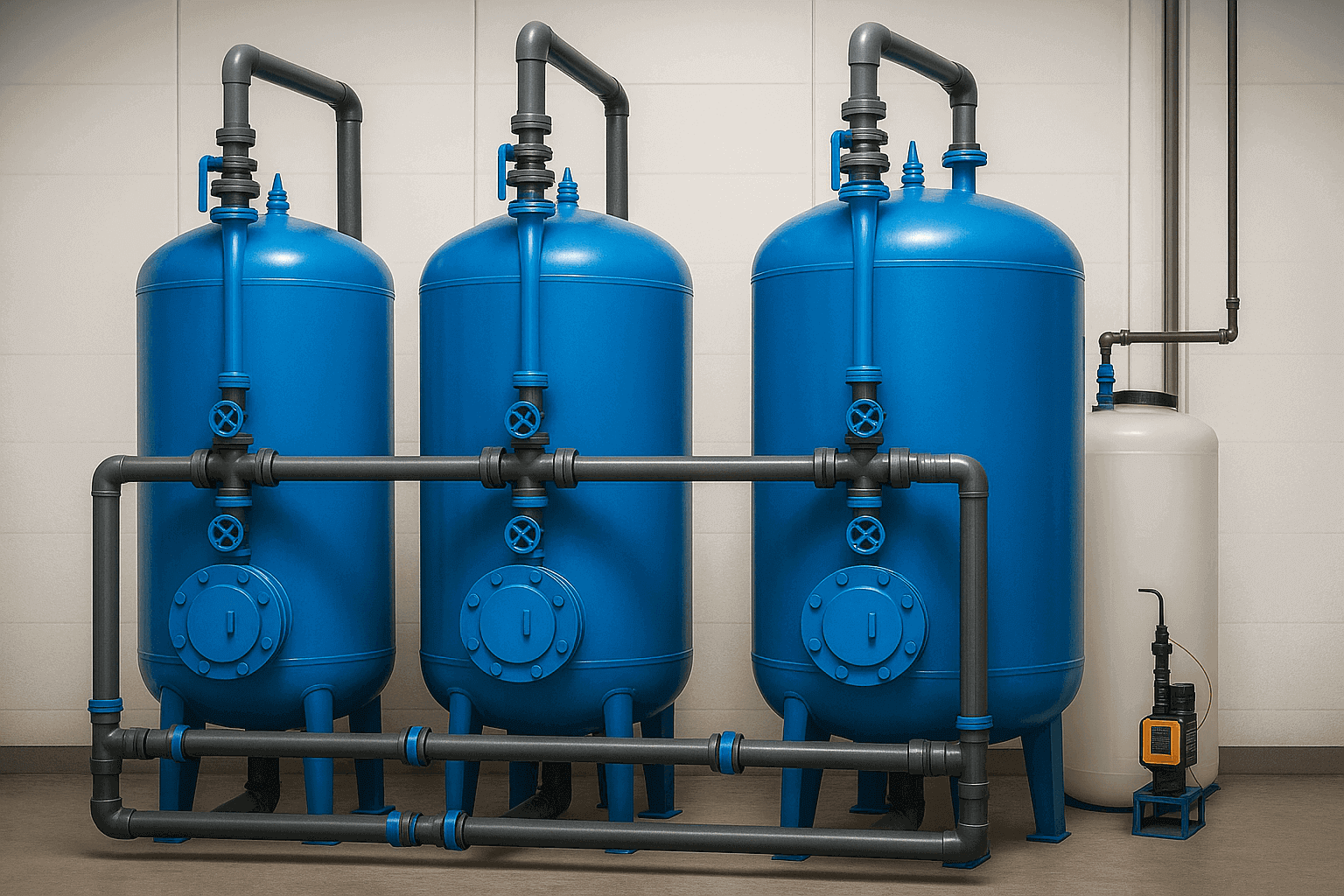
An Ion Exchange System is used to remove the calcium and magnesium from the water. The process, requiring only salt and small amount of electricity to operate. WLT manufactures package and industrial type of softners for softening water containing high levels of hardness. WLT softeners in corporate the state of the art technology design for an effective regeneration to make the ultimate cost cheaper by simplest operation. WLT package and industrial softeners are available in different sizes. WLT also manufactures custom-made system to treat hard water with the strong back up of after sales service STANDARD FEATURES » Packed Bed & Down flow softening system. » Epoxy lined or Rubber lined MS pressure tanks » FRP Pressure tanks » Top & Side Mounted Manway. » Stainless Steel, UPVC, or MS Internal Water Distributing Piping. » Multiport valve or Conventional valve arrangement on UPVC or MS external frontal piping. » Manual and Fully automatic operations
"Demineralization System (SAC + SBA + MB)" are terms used in different contexts:
A Demineralization (DM) system, often paired with Mixed Bed (MB) technology, is a water treatment process used to remove dissolved minerals and ions from water, producing high-purity, demineralized water. This process is commonly used in various industrial applications where low conductivity and high-purity water are required. Here's how the DM and MB system typically works: 1. Demineralization (DM) Process: Ion Exchange Resins: The DM process utilizes ion exchange resins, which are small, porous beads with functional groups that attract and exchange ions in water. Cation Exchange: In the first stage of DM, cation exchange resins are used to remove positively charged ions (cations) such as calcium (Ca2+), magnesium (Mg2+), sodium (Na+), and iron (Fe2+). These cations are exchanged with hydrogen ions (H+) or other less objectionable cations on the resin beads. Anion Exchange: In the second stage, anion exchange resins remove negatively charged ions (anions) such as chloride (Cl-), sulfate (SO42-), nitrate (NO3-), and carbonate (CO32-). These anions are exchanged with hydroxide ions (OH-) or other less objectionable anions on the resin beads. Regeneration: Over time, the ion exchange resins become exhausted as they accumulate ions. Regeneration involves passing concentrated solutions of acids (for cation resins) and bases (for anion resins) through the resin beds to displace and remove the trapped ions, restoring the resins' ion exchange capacity. 2. Mixed Bed (MB) Process: Final Polishing: After passing through the DM system, the water may still contain trace amounts of ions. The mixed bed (MB) process serves as a final polishing step to further remove any remaining ions and produce ultra-pure water. Mixed Bed Resin: Mixed bed systems contain a mixture of cation and anion exchange resins in a single vessel. This arrangement allows for thorough removal of ions by providing continuous ion exchange capacity. High Purity Water Production: In the mixed bed, cations and anions are exchanged simultaneously, resulting in exceptionally high-purity water with extremely low conductivity. 3. Applications: Boiler Feedwater: Demineralized water produced by DM and MB systems is commonly used as boiler feedwater in power plants and industrial boilers to prevent scale formation and corrosion. Electronics and Semiconductor Manufacturing: Ultra-pure water is essential for electronics and semiconductor manufacturing processes, where even trace levels of impurities can affect product quality and performance. Pharmaceuticals: Demineralized water is used in pharmaceutical manufacturing for drug formulation, cleaning, and other critical processes requiring high-purity water. Laboratory Applications: High-purity water is also used in laboratories for analytical testing, experiments, and equipment calibration. In summary, Demineralization (DM) systems, often complemented by Mixed Bed (MB) technology, are integral to various industries requiring ultra-pure water for critical processes and applications. These systems effectively remove dissolved minerals and ions, producing water with exceptionally low conductivity and high purity.
"Iron Removal Filter (IRF)" are terms used in different contexts:
Remove Metallic Contaminants for Clearer Water Iron and manganese are frequently found in groundwater sources, leading to rusty discoloration, foul taste, and sediment deposition in water systems. Left untreated, these elements can damage plumbing fixtures, stain surfaces, and interfere with industrial equipment. Our Iron Removal Filters are designed to target and eliminate dissolved iron and manganese through oxidation and filtration using advanced catalytic media. Water Link Technologies supplies IRFs with both manual and automatic backwashing capabilities, ensuring consistent performance with minimal human intervention. These filters are commonly installed in residential borewell systems, industrial processing units, and municipal water supplies. Our solutions are tailored to meet varying water quality challenges, ensuring clean, clear, and odor-free water that complies with safety and aesthetic standards
"Electro Deionization (EDI)" are terms used in different contexts:
Electro Deionization (EDI) is a next-generation technology that purifies water to ultra-low conductivity levels by removing dissolved ions through electrically active membranes. Unlike traditional mixed-bed deionizers that require frequent regeneration using harsh chemicals, EDI operates continuously without chemicals, making it a sustainable and environmentally responsible solution. At Water Link Technologies, our EDI systems are commonly integrated downstream of reverse osmosis units to polish RO permeate and achieve ultra-pure water suitable for electronics manufacturing, pharmaceutical formulation, laboratories, and power plants. EDI combines ion exchange resins, ion-selective membranes, and a DC power supply to drive ion removal, making it efficient, compact, and maintenance-friendly. Our systems offer high recovery rates, reduced operating costs, and reliable water quality without the need for chemical handling or storage. With consistent performance and a long service life, EDI is the ideal solution for industries that demand the highest level of water purity with minimal environmental impact.
Why Our Service
Business it will frequently occur pleasures have to repudiated annoyances that accepted wises man therefore always hold the saying through shrinking.