Designed with the best filtration and disinfection systems.
- +917096592479
- Mon - Sat: 08.00 to 08.00
Zero Liquid Discharge through Thermal Concentration
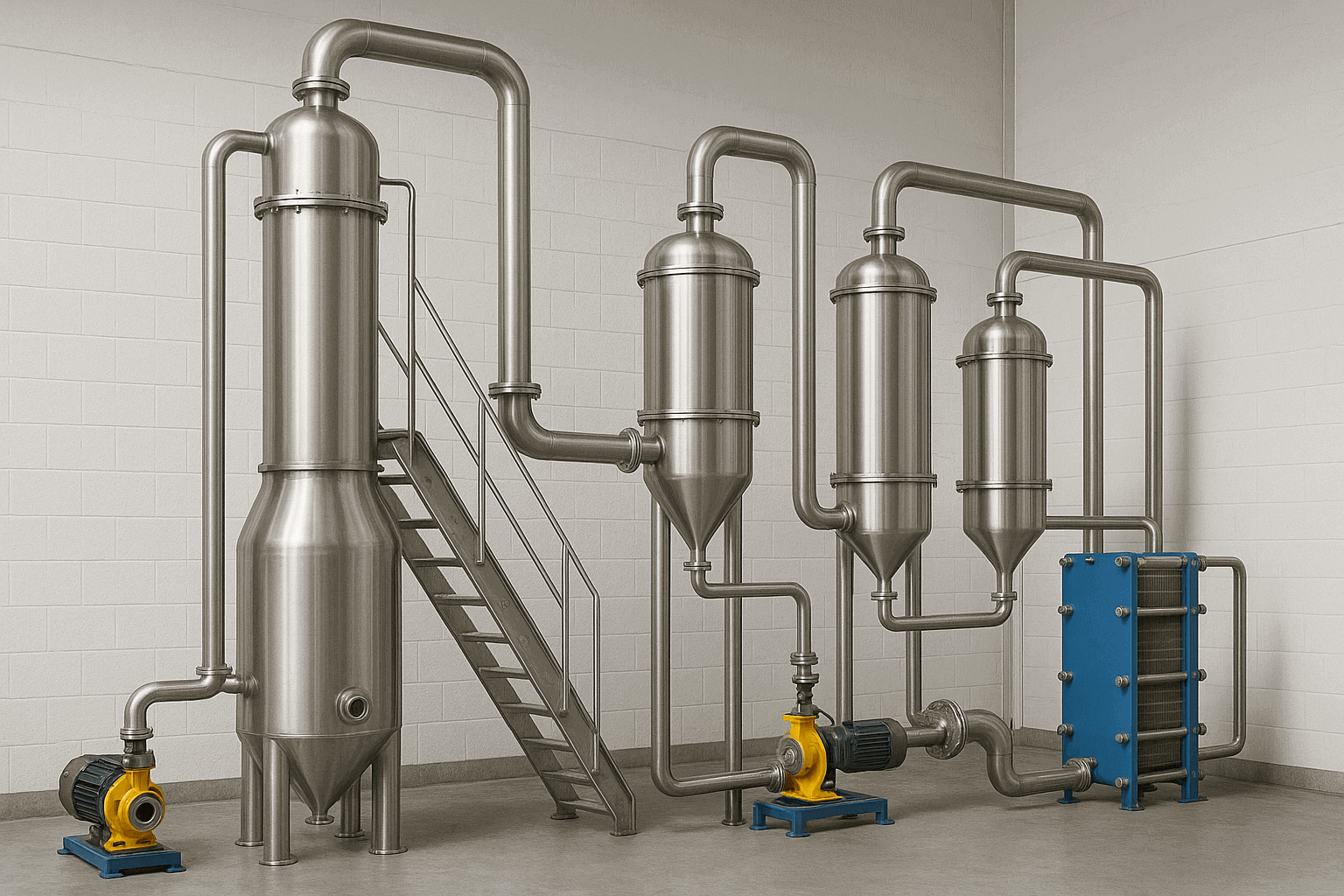
Our Evaporation Systems provide an energy-efficient method to concentrate wastewater and recover usable water by evaporating the liquid fraction. These systems help industries achieve Zero Liquid Discharge (ZLD) goals by minimizing liquid effluent and turning waste into reusable byproducts. Ideal for textile, pharma, chemical, and food processing units, our evaporation plants combine thermal design with automation for long-term performance."Multiple Effect Evaporation (MEE)" are terms used in different contexts:

Multiple Effect Evaporation (MEE) is a thermal desalination process used to concentrate saline solutions or wastewater streams by evaporating water and leaving behind dissolved solids. This process is commonly employed in various industries, including wastewater treatment, chemical manufacturing, food processing, and seawater desalination. Here's how MEE works: 1. Principle of Operation: MEE operates on the principle of utilizing the latent heat of vaporization to evaporate water from a feed solution. The evaporated water vapor is then condensed and recovered, leaving behind a more concentrated solution or brine. 2. Multiple Evaporator Stages: MEE consists of multiple evaporator stages or effects arranged in series. Each effect operates at a progressively lower pressure and temperature, utilizing the vapor generated in the preceding stage as a heating source for the next stage. This arrangement maximizes energy efficiency by utilizing the latent heat of vaporization across multiple stages. 3. Heat Transfer: In each evaporator stage, heat is supplied to the feed solution, causing water to evaporate and form vapor. The vapor rises and comes into contact with a surface, such as a heat exchanger tube or plate, where it condenses back into liquid form. This condensed liquid is collected as distillate or product water. 4. Concentration Effect: As the feed solution flows through each evaporator stage, its concentration increases as water is continuously evaporated and removed. The concentrated solution or brine is withdrawn from the final stage, while the distillate collected from the earlier stages is typically of higher purity. 5. Energy Efficiency: MEE systems are designed to optimize energy efficiency by utilizing the heat from the condensing vapor to heat the incoming feed solution in the subsequent stage. This process, known as thermal vapor compression or mechanical vapor compression, reduces the overall energy consumption of the system compared to single-effect evaporation. 6. Applications: MEE is used in various industrial applications to concentrate and treat wastewater streams, recover valuable products from process solutions, and desalinate saline water sources. It is particularly suitable for treating high-salinity brines, such as those generated from desalination plants, industrial processes, or mining operations. 7. Pre-treatment and Post-treatment: MEE systems may be integrated with pre-treatment and post-treatment processes to remove suspended solids, dissolved gases, and other impurities before and after evaporation. This ensures the efficient operation and longevity of the MEE system while producing a high-quality distillate. In summary, Multiple Effect Evaporation (MEE) is an energy-efficient thermal desalination process used to concentrate saline solutions or wastewater streams by evaporating water across multiple stages. It finds widespread application in various industries where concentration or purification of liquid streams is required.
"Mechanical Vapour Re-Compression Evaporator (MVR)" are terms used in different contexts:
In water treatment, Mechanical Vapor Recompression (MVR) evaporators are utilized for concentrating wastewater streams, brines, or other liquid solutions by evaporating water under reduced pressure. MVR technology offers significant advantages in terms of energy efficiency and operational cost savings compared to conventional thermal evaporation methods. Here's how MVR evaporators are typically employed in water treatment: 1. Concentration of Wastewater: MVR evaporators are commonly used to concentrate wastewater streams generated from industrial processes, municipal sewage treatment plants, or desalination plants. These wastewater streams often contain dissolved solids, contaminants, and pollutants that need to be concentrated for disposal or further treatment. 2. Brine Concentration: MVR evaporators are also employed to concentrate brine streams produced from desalination processes, such as reverse osmosis (RO) or multiple effect distillation (MED). Brine concentration reduces the volume of waste generated and allows for the recovery of valuable salts or minerals from the brine. 3. Energy Efficiency: One of the key advantages of MVR evaporators is their high energy efficiency. By utilizing mechanical compression to recycle and recompress the vapor generated during evaporation, MVR systems recover the latent heat of vaporization, significantly reducing energy consumption compared to conventional evaporators. 4. Cost Savings: MVR evaporators offer cost savings in terms of reduced energy consumption, lower operating costs, and decreased disposal costs for concentrated waste streams. This makes MVR technology an economically attractive option for water treatment applications, especially in regions where energy costs are high. 5. Zero Liquid Discharge (ZLD) Systems: MVR evaporators are often integrated into Zero Liquid Discharge (ZLD) systems, which aim to minimize or eliminate liquid waste discharge from industrial processes. By concentrating wastewater streams to the point where only solid residues remain, MVR evaporators help achieve ZLD objectives and comply with environmental regulations. 6. Customization and Integration: MVR evaporators can be customized and integrated into existing water treatment processes or wastewater treatment plants to meet specific treatment objectives and capacity requirements. They can operate standalone or as part of a multi-stage treatment train, depending on the characteristics of the feedwater and the desired output. 7. Environmental Sustainability: MVR technology contributes to environmental sustainability by reducing energy consumption, minimizing liquid waste disposal, and conserving water resources. It offers a more environmentally friendly alternative to traditional evaporation methods, which may rely on fossil fuels or generate greenhouse gas emissions. In summary, Mechanical Vapor Recompression (MVR) evaporators play a crucial role in water treatment by concentrating wastewater streams, brines, and other liquid solutions with high energy efficiency and cost savings. They are widely used in various water treatment applications to achieve environmental compliance, resource recovery, and sustainable water management.
"Agitated Thin Film Dryer (ATFD)" are terms used in different contexts:
The Agitated Thin Film Dryer (ATFD) is a specialized type of evaporator used in water treatment processes to concentrate liquid solutions or slurries, particularly those with heat-sensitive or viscous components. ATFDs are designed to efficiently evaporate water while minimizing thermal degradation of the product. Here's how ATFDs are typically employed in water treatment: 1. Operating Principle: The ATFD operates on the principle of creating a thin film of liquid on the inner surface of a vertically oriented cylindrical vessel. Heat is applied to the vessel's jacket or heating elements, causing the liquid film to evaporate as it flows downward under the influence of agitation. 2. Agitation Mechanism: Agitation is achieved using rotating blades or paddles within the vessel, which continuously scrape and spread the liquid film across the heated surface. This agitation helps to maintain a uniform film thickness and enhances heat transfer efficiency. 3. Thin Film Formation: The liquid feed enters the ATFD vessel at the top and is evenly distributed over the inner surface to form a thin film. The film thickness is typically in the range of a few millimeters to micrometers, maximizing the surface area available for evaporation. 4. Evaporation and Vaporization: As the liquid film flows downward, heat is transferred from the vessel's heating elements to the film, causing the water to evaporate and form vapor. The vapor is removed from the vessel through a vapor outlet, while the concentrated product or residue is collected at the bottom of the vessel. 5. Heat Sensitivity and Viscosity: ATFDs are particularly well-suited for treating heat-sensitive or viscous liquids, as the short residence time and gentle evaporation process minimize thermal degradation and product fouling. This makes ATFDs ideal for concentrating solutions containing delicate compounds or high-viscosity materials. 6. Energy Efficiency: ATFDs offer high energy efficiency compared to other evaporation technologies, thanks to their ability to operate at relatively low temperatures and vacuum conditions. This reduces energy consumption and operating costs while preserving the quality of the concentrated product. 7. Applications: In water treatment, ATFDs are used to concentrate various liquid solutions, including wastewater streams, brines, industrial effluents, and process liquors. They find application in industries such as pharmaceuticals, food processing, chemicals, pulp and paper, and environmental engineering. 8. Integration and Customization: ATFDs can be integrated into existing water treatment processes or configured as standalone units to meet specific treatment objectives and capacity requirements. They can be customized with various options, such as different heating methods, materials of construction, and agitation designs, to suit the characteristics of the feed solution. In summary, Agitated Thin Film Dryers (ATFDs) play a valuable role in water treatment by efficiently concentrating liquid solutions while preserving the quality of heat-sensitive or viscous products. They offer high energy efficiency, gentle evaporation, and versatility, making them suitable for a wide range of industrial applications.
Why Our Service
Business it will frequently occur pleasures have to repudiated annoyances that accepted wises man therefore always hold the saying through shrinking.