Designed with the best filtration and disinfection systems.
- +917096592479
- Mon - Sat: 08.00 to 08.00

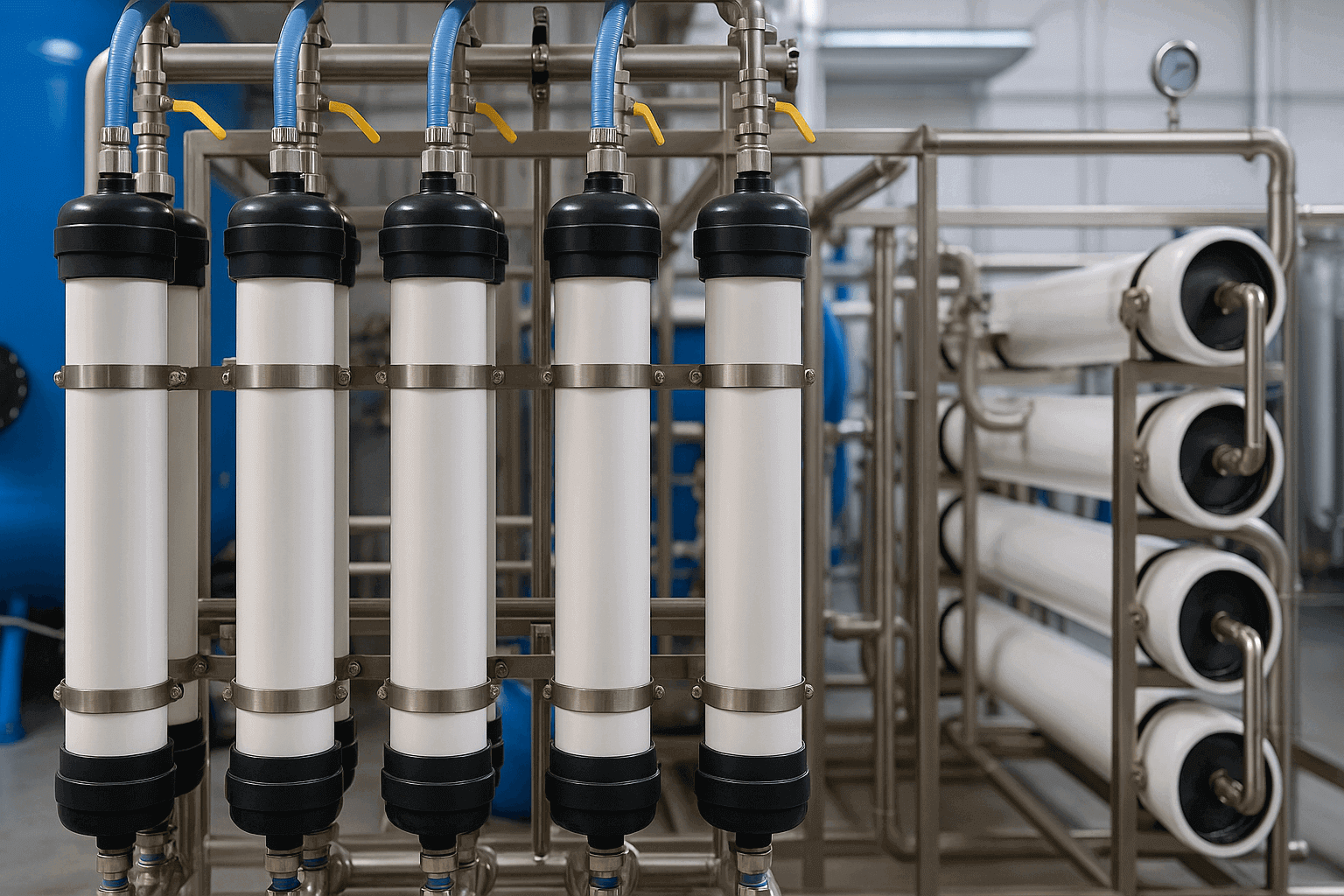
Advanced Separation Technology for High-Purity Water
Our Membrane Base Filtration Systems are designed to remove microscopic contaminants and dissolved solids through precision membranes. Whether it’s for pre-treatment, wastewater recycling, or high-purity process water, Water Link Technologies provides scalable membrane solutions including UF, MBR, NF, and RO systems. With automated controls, energy-efficient designs, and high rejection rates, these systems are perfect for industries like pharmaceuticals, food & beverage, and chemical processing"Ultrafiltration System (UF System)" are terms used in different contexts:

Ultrafiltration (UF) is a type of membrane filtration process that operates at relatively low pressure and is used to separate suspended solids, colloids, bacteria, viruses, and other macromolecules from water or other fluids. Here's an overview of the Ultrafiltration system: 1. Membrane: The core component of the UF system is the semi-permeable membrane. This membrane contains tiny pores that allow water and low molecular weight solutes to pass through while blocking larger particles and molecules. 2. Process: In the UF process, the feed water is pumped through the membrane under pressure. The pressure forces water and small molecules to pass through the membrane, leaving behind larger particles and contaminants. The filtered water, known as permeate, is collected on the other side of the membrane, while the concentrated solution containing retained particles, called retentate, is discharged. 3. Pore Size: The size of the pores in the UF membrane typically ranges from 0.01 to 0.1 micrometers (µm). This allows UF to effectively remove particles such as suspended solids, bacteria, viruses, proteins, and some macromolecules from the water.
"MBR System (MBR System)" are terms used in different contexts:
In the context of a water treatment plant, MBR can stand for "Membrane Bioreactor" rather than "Master Boot Record" Let's explore the Membrane Bioreactor system in water treatment: 1. Process Overview: The Membrane Bioreactor (MBR) system is a wastewater treatment process that combines biological treatment with membrane filtration. It's an advanced technology used in treating both municipal and industrial wastewater. 2. Biological Treatment: In the MBR system, wastewater undergoes biological treatment, where microorganisms break down organic matter and pollutants present in the water. This biological process is similar to traditional activated sludge treatment. 3. Membrane Filtration: The distinguishing feature of the MBR system is the use of membrane filtration. Instead of settling tanks to separate treated water from sludge, membranes with tiny pores are employed to filter out suspended solids, bacteria, and pathogens. This results in a higher quality of treated water.
"Nano filtration System (NF System)" are terms used in different contexts:
In a water treatment plant, a nano filtration (NF) system is a specialized membrane filtration process used to treat water by selectively removing dissolved solutes, ions, and certain organic compounds while allowing water molecules and smaller ions to pass through. Here's how NF systems are typically utilized in water treatment plants: 1. Pre-Treatment: NF systems can be employed as a pre-treatment step before other advanced treatment processes such as reverse osmosis (RO) or ion exchange. In this context, NF helps to remove divalent ions (e.g., calcium, magnesium) and larger organic molecules, reducing the load on downstream treatment units and improving their efficiency. 2. Desalination: NF is commonly used in brackish water desalination applications, where it selectively removes salts and hardness ions from the feed water, producing softened water with reduced salt content. NF is particularly effective for treating water sources with lower salinity levels compared to seawater, making it suitable for inland brackish water desalination projects. 3. Color and Organic Matter Removal: NF can also be employed for color and organic matter removal in surface water treatment plants. By selectively removing larger organic molecules responsible for color and taste, NF helps improve the aesthetic quality of the treated water, making it more suitable for drinking and other municipal uses. 4. Water Softening: In areas with hard water containing high concentrations of calcium and magnesium ions, NF can be used for water softening purposes. NF selectively removes divalent ions responsible for water hardness, resulting in softened water that is less prone to scale formation and can extend the lifespan of downstream equipment and plumbing systems. 5. Selective Ion Removal: NF can selectively remove specific ions from water based on their size and charge. This property makes NF useful for targeted removal of contaminants such as nitrate, sulfate, fluoride, and heavy metals, helping to meet regulatory standards for drinking water quality. 6. Process Optimization: NF systems are often integrated into multi-stage treatment trains within water treatment plants to optimize overall treatment performance and achieve desired water quality objectives. By selectively removing specific contaminants, NF helps tailor the treatment process to the characteristics of the raw water source and the quality requirements of the treated water. Overall, NF systems play a critical role in water treatment plants by providing a versatile and effective solution for removing contaminants, softening water, and improving water quality for various municipal and industrial applications.
"Reverse osmosis System (RO System)" are terms used in different contexts:
Reverse Osmosis (RO) plants are widely used in industrial settings for water purification and treatment. They utilize semipermeable membranes to remove contaminants, dissolved solids, and impurities from water by applying pressure to overcome osmotic pressure. Here's how RO plants are typically used in industrial applications: 1. Water Purification: RO plants are employed to purify water by removing a wide range of contaminants, including dissolved salts, minerals, heavy metals, organic compounds, bacteria, and viruses. This makes RO ideal for treating various water sources, including brackish water, seawater, groundwater, and surface water, to produce high-quality, potable water suitable for industrial processes or drinking purposes. 2. Desalination: RO is particularly well-suited for desalinating seawater and brackish water sources to produce freshwater for industrial applications, such as power generation, manufacturing, agriculture, and municipal water supply. RO desalination plants utilize high-pressure pumps to force seawater through semipermeable membranes, separating salt and other impurities from the water stream and yielding freshwater as the permeate. 3. Boiler Feedwater Treatment: In industrial facilities with steam boilers, RO plants are commonly used to treat boiler feedwater by removing dissolved solids and impurities that can cause scale formation, corrosion, and fouling in boiler systems. By producing high-quality, low-conductivity feedwater, RO helps improve boiler efficiency, prolong equipment lifespan, and reduce maintenance costs. 4. Process Water Treatment: RO plants are integral to many industrial processes that require purified water, such as pharmaceutical manufacturing, electronics fabrication, food and beverage processing, chemical production, and semiconductor manufacturing. RO-treated water is used as a raw material, process ingredient, or cooling water in various industrial applications where water quality is critical to product quality and process integrity. 5. Wastewater Reclamation: In some industrial settings, RO plants are used for wastewater reclamation and recycling to recover valuable resources, such as clean water and dissolved chemicals, from wastewater streams. RO-treated wastewater can be reused for non-potable purposes, such as irrigation, industrial processes, or facility cooling, reducing freshwater consumption and wastewater discharge. 6. Customization and Optimization: RO plants can be customized and optimized to meet the specific water quality requirements, capacity demands, and operating conditions of industrial facilities. Factors such as membrane selection, system design, pretreatment processes, and operating parameters are tailored to achieve optimal performance, efficiency, and cost-effectiveness in industrial RO applications. Overall, RO plants play a critical role in industrial water treatment by providing reliable, cost-effective solutions for purifying water, treating process streams, and meeting stringent water quality standards in a wide range of industrial sectors.
Why Our Service
Business it will frequently occur pleasures have to repudiated annoyances that accepted wises man therefore always hold the saying through shrinking.